How Little We Sea
So many of my fellow Earthlings See so little of our Seas
In spite of living on a Blue Planet.
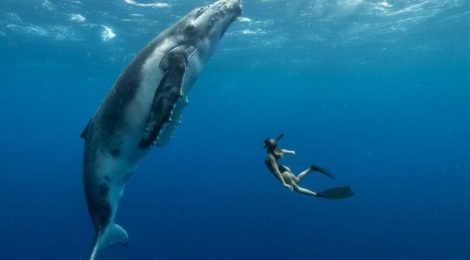
We see the shoreline. We see the surface. And we imagine we see the bottom of the ocean. We see or even imagine very little of the in-between, which is in fact the very vast majority of the oceans. It is in this in-between blue world where 99% of all life on this blue planet exists. What happens in this in-between is the most important of all things that happen on our entire planet Earth/Ocean.
This in-between blue world is so vast and mysterious one needed bend one’s imagination towards aliens visiting from across vast expanses of space, travelling from light-years away to be curious about what’s going on with a small blue dot in space. Within this in-between world aliens abound beyond our wildest imagination. We know a few like Mody Dick the great white whale, Flipper his small cousin, giant squid and tiny, beautiful sardines, even SpongeBob and friends.
The in-between hosts the greatest migration on Earth, yet almost no one knows about it. Every single day, as twilight descends upon the ocean surface, billions upon billions of tiny creatures – zooplankton, small fish, krill, and jellyfish – rise from depths of 300 to 1000 meters to feed in the plankton-rich surface waters. Come dawn, they descend back into the twilight zone to rest and hide from predators. This Diel Vertical Migration, as scientists call it, moves more living biomass than all the wildebeest of the Serengeti, all the caribou of the Arctic, all the monarch butterflies of North America combined. It happens every 24 hours, sweeping across the world’s oceans in a massive living wave that was first discovered during World War II when sonar operators thought they’d found a false seafloor that mysteriously rose and fell with the sun.
The in-between is also where the ocean performs its most vital climate service. As zooplankton feed at the surface each night and return to the depths each day, they transport carbon from the atmosphere into the deep ocean through a process called “active transport.” Through their feeding, waste, and eventual death, these creatures move tens of billions of tonnes of carbon per year into the abyss, where it can remain locked away for millennia. This biological pump, powered by the daily rhythms of creatures smaller than a grain of rice, helps regulate Earth’s climate more effectively than any technology humanity has yet devised. Scientists estimate that 95% of the world’s fish biomass by weight lives in this twilight zone – a vast reservoir of life that remains largely beyond our sight and understanding.
Our religions have honored life in this dark blue in-between, think of Jesus and his Miracle of the Fishes or the Portuguese Patron Saint St. Anthony of Padua (Anthony of Lisbon) who is revered for the legend of preaching to the fish when men would not listen and who learned wisdom from the fish leading to plentiful harvests of Sardines (the very icon of Portugal). How about the venerated Stella Maris (Star of the Sea)? She is a patron of the maritime world; you may know her better as The Virgin Mary. Or Yulan in Chinese tradition, manifestation of the Goddess of Mercy, often depicted holding a basket of fish, serving as a protector of those who live by the sea. Perhaps you know of Matsya in Hindu traditions, the first avatar of Vishnu, who took the form of a fish to protect the first man.
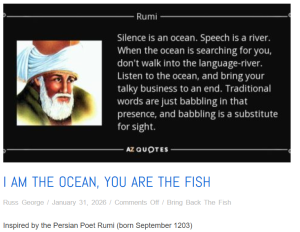
Persian poet, of nearly a thousand years ago, Rumi taught that the holiest of holies is the ocean and we are her fish!
Click to read more
The shoreline we are most familiar with is truly a wonder, but it is but a tiny fraction of the ocean. Sure, it is steadfast in showing the bathing beauties, whether they be the colorful reef fish or comely maidens, but to cease our attention in those waist-deep waters and ignore what is happening beyond and beneath is worse than folly; it is neglect.
The surface where seabirds swoop and dip, and upon which the power of the ocean waves never ceases to put us in awe, is another thing of beauty, but an ever-so-tiny fraction of the whole.
The bottom, in the abyssal, permanent darkness, is almost beyond the imagination and certainly beyond the experience of more than 1000 humans who have ventured into the few incredible spaceships that are required to travel there.
What is in-between in the twilight and the dark waters between and beyond our familiar ocean fringes is where we have steadfastly ignored the ocean, save for the secret military exploitations or the rapacious industrial trawling of this in-between world’s bounty of life.
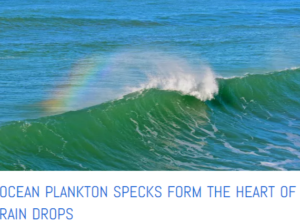
Life in the oceans begins at the surface where her ocean plankton pastures bloom and convert sunlight, CO2, and minerals into additional life. On land, on Earth, it was 10,000 years ago that humanity learned about taking care of pastures so that they would, in turn, take care of and provide for us. Sadly, upon the 70+% of this Blue Planet that is ocean, we have yet to begin to take care of our ocean pastures. These pastures, almost all well out of sight of land, make 90+% of the oxygen all life breathes. These pastures of plankton produce microscopic particles that allow for the condensation of moisture into clouds, and when those clouds blow ashore, they provide the rain upon which pastures on land depend. At the heart of every raindrop is a tiny speck of plankton!
Click to read more
Yet we are witnessing a tragedy of biblical proportions playing out in this in-between world, and almost no one is paying attention. Since the 1950s, ocean pastures have been collapsing at a rate of approximately 1% per year. To put this in terrestrial terms that might shake us from our complacency: we have lost ocean plant life equivalent to an entire Amazon Rainforest every five years. Count them up – that’s 10 complete Amazon Rainforests worth of ocean life that has simply vanished in the past half-century. The world agonizes over the loss of 20% of the Amazon on land, yet remains blind to the eradication of ten entire Amazons at sea.
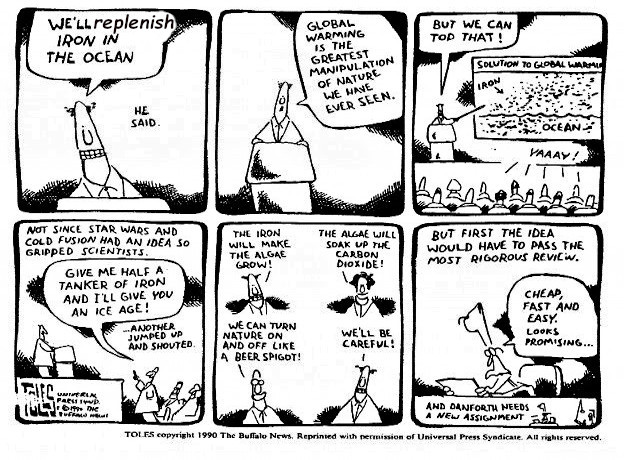
The cause? Our high and rising CO2 has created what I call “global greening” on land – more grass growing means less dust blowing. And it is dust in the wind, mineral-rich dust from the continents, that has always nourished the ocean pastures. We’ve created a drought of dust, and the oceans are dying of thirst for minerals. Think of dust as the yang to the yin of rain that keeps our pastures on land green and alive.
The Late Great Professor John Martin
The consequences ripple through the entire ocean food web. Seabird populations are crashing, with hundreds of thousands washing up dead on beaches around the world. Sea lion mothers, unable to find enough fish, abandon their pups to starve on California beaches. Fisheries from sardines to tuna to salmon have collapsed, not primarily from overfishing as we’re told, but from the catastrophic decline in the carrying capacity of their ocean pastures. When there isn’t enough plankton grass to feed the small fish, there aren’t enough small fish to feed the larger ones, and the pyramid of ocean life crumbles from its foundation. Pastures, whether on land or in the oceans, are defined by their carrying capacity – the amount of animal life the pasture can sustain, whether the animals are goats, sheep, cattle, zebras, or fish.
Yet there is hope in this story, and it comes from the very in-between world we have neglected. In 2012, working with the indigenous people of Haida Gwaii, we restored a dying ocean pasture in the North Pacific by replenishing it with mineral-rich dust – giving back to the ocean what our CO2-driven drought had denied it. The results were stunning: 30,000 square kilometers of blue desert transformed into an emerald sea teeming with life. Where once there was clear, lifeless blue water, satellites revealed verdant blooms of a hundred million tonnes of plankton and the entire food chain it supports. The following year, Pink Salmon returns to Alaska reached 226 million fish – the largest catch in recorded history, compared to the forecast of just 50 million. Nature showed us that when we care for ocean pastures, they will care for us in return.
The lesson is clear: just as humanity learned 10,000 years ago to tend land pastures, we must now learn to tend ocean pastures. The technology is proven, safe, and remarkably cost-effective. By restoring the natural flow of mineral dust to ocean pastures, we can bring back the fish, restore the biological pump that regulates our climate, bring back the cooling clouds and the rain, and revive the very lungs of our planet.
At the heart of nearly every bit of cloud and raindrop lies a tiny speck of plankton. These ocean pastures, with their mega-trillion-fold complexity, may possess a form of distributed intelligence – a quantum consciousness where the bloom’s “mind” emerges from the interplay of its parts, much like consciousness arises from neurons in a brain. The pastures literally sing, communicating across vast distances through ultra-low frequency sounds, chemical signals, and the coordinated behavior of countless organisms acting as one.
We must see more of our seas. We must recognize that the in-between – this vast, mysterious, life-giving realm – is not separate from us but is the very foundation of life on Earth. What happens in this twilight world affects every breath we take, every raindrop that falls, every fish that swims, every cloud that forms.
The time has come to be the stewards our ocean pastures deserve. The time has come to truly see our seas.