
THE VITAL OCEAN CONNECTION
Why Dying Seas Mean Disappearing Clouds
Part Two of Three: Ocean Pastures, Clouds, and Climate
© By Russ George
The Smell of the Sea Is Disappearing
Have you ever smelled a fragrant rose? Or the scent of a pine forest? Or perhaps you’ve stood on a rocky coast and breathed in that unmistakable salt-and-sulfur tang of the ocean. If you have you’ve inhaled some of the most important molecules on Earth. Those fragrances of plant life are terribly important, not only to please our senses, they also control our climate.
The smell of the ocean has a name: dimethyl sulfide, or DMS. It’s produced by the living ocean—by the countless trillions upon trillions of phytoplankton and bacteria that inhabit the sunlit surface waters of every sea.
DMS doesn’t just smell like the sea. In a very real sense, because this is a Blue Planet, above and beyond all other things it makes the weather. When DMS molecules escape the ocean surface and enter the atmosphere, they oxidize into tiny sulfate aerosol particles—each one about 0.2 microns across. And those infinitesimal particles do something extraordinary: they become the seeds around which clouds form.
No seeds, no clouds. It’s that simple. And that terrifying. Because over the vast open ocean—72% of Earth’s surface—biology is the primary manufacturer of cloud seeds. Not volcanoes. Not pollution. Life.
In the first article of this series, we documented the 2025 breakthrough discoveries showing that Earth’s cloud cover is in dramatic decline, that the resulting albedo loss accounts for 85% of the planet’s reduced reflectivity, and that this cloud crisis has added heating equivalent to more than 70% of all greenhouse gas emissions from the entire 20th century.
But those papers identified the what without explaining the why. Now it’s time to follow the evidence to its source—deep into the living ocean, where the collapse of the world’s great plankton pastures is silently dismantling our planet’s most powerful cooling system.
Nature’s Cloud Factory: How It Works
Here’s the remarkable chain of events that connects a microscopic alga floating in the Pacific to a cloud formation a thousand kilometers away.
Phytoplankton—the tiny photosynthetic organisms that form the base of the ocean food web—produce enormous quantities of a compound called DMSP (dimethylsulphoniopropionate). How much? Over one billion tonnes per year. That makes DMSP one of the most abundant organic sulfur compounds on Earth. Research at ETH Zurich has shown that roughly 10% of all ocean photosynthesis is dedicated to producing this single molecule.
Think about that. The ocean’s living systems devote a tenth of their total photosynthetic energy—an almost inconceivable investment of biological resources—to manufacturing cloud-forming molecules. Evolution doesn’t make investments like that on a whim. This is nature’s air conditioning system, refined over billions of years.
DMSP serves multiple functions in the ocean. It satisfies 95% of marine bacteria’s sulfur demand and 15% of their carbon demand. It’s a fundamental building block of ocean life. But its atmospheric destiny is what makes it a planetary thermostat.
The Critical Fork: Bloom vs. Desert
Here’s where the chemistry gets fascinating—and where it connects directly to the crisis we face.
Marine bacteria have two metabolic pathways for processing DMSP. Which pathway they choose depends on concentration:
At high concentrations—the conditions found in healthy, thriving plankton blooms—bacteria cleave the DMSP molecule. This releases DMS into the water, and from there into the atmosphere. The sulfur escapes. The clouds get made.
At low concentrations—the conditions found in depleted, barren ocean waters—bacteria demethylate DMSP instead. They strip it down and retain both the sulfur and carbon for their own survival. No DMS is released. No cloud seeds are produced.
This is a threshold mechanism. It means that DMS production doesn’t decline gradually as ocean productivity falls. It drops off a cliff once plankton densities fall below a critical level. A moderately depleted ocean pasture doesn’t produce moderately fewer clouds. It can produce almost no cloud seeds at all.
When ocean pastures cross the threshold from bloom to desert, the cloud factory doesn’t dim. It shuts down.
The Great Ocean Pasture Collapse
Now for the numbers that should alarm everyone working on climate change.
Satellite data, ship-based measurements, Secchi disk records, and multiple converging lines of evidence show that global ocean phytoplankton productivity has declined by 50++% since the 1980s. In some regions—particularly the North Pacific, the North Atlantic, and parts of the Southern Ocean—the decline has been even more severe.
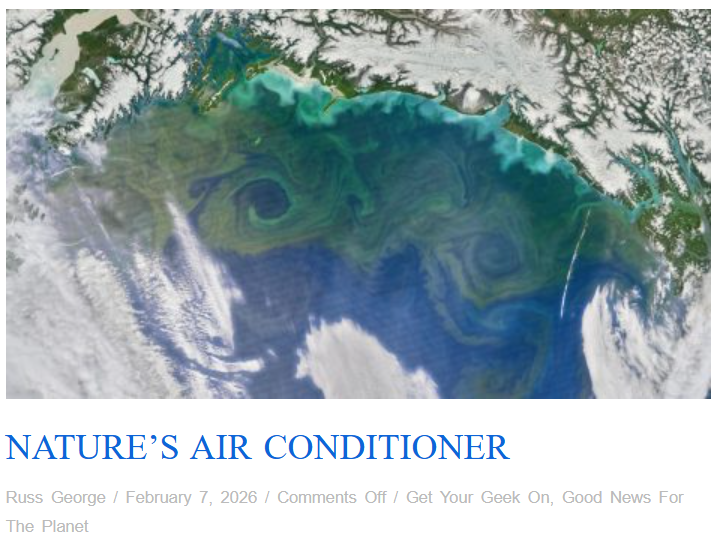
I call these depleted waters “blue deserts” because that’s precisely what they are. Viewed from space, healthy ocean pastures are tinged green with chlorophyll—the signature of abundant life. The blue deserts are a crystalline, beautiful, empty blue. They’re the ocean equivalent of a perfectly barren sand dune. Visually stunning. Biologically dead.
The primary driver of this collapse is the decline in atmospheric iron-rich mineral dust deposition to the ocean surface. Ocean phytoplankton in the vast high-nutrient, low-chlorophyll (HNLC) regions of the ocean have plenty of nitrogen and phosphorus but are starved for iron. Historically, wind-borne dust from continental deserts and arid lands delivered that iron. But changes in land use, vegetation patterns, and atmospheric circulation have reduced dust transport to the ocean by dramatic amounts over recent decades.
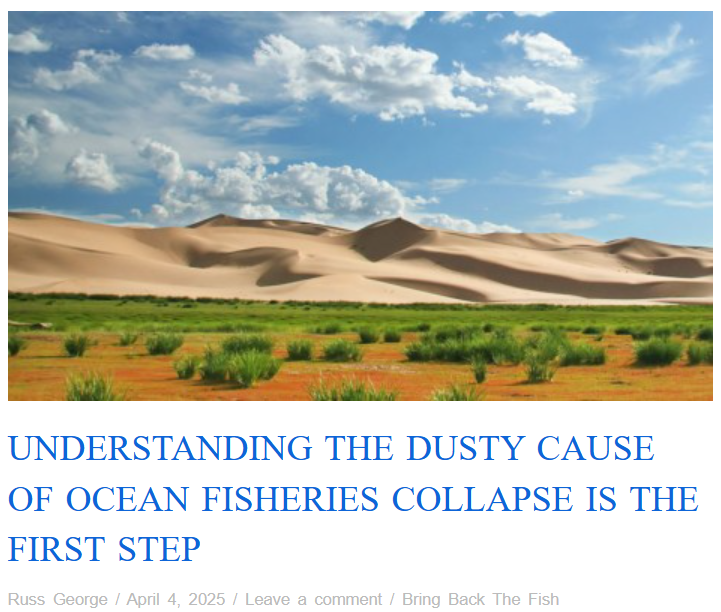
Asian dust has declined by 80% in the past few decades. Click to read more …
Without iron, the ocean pastures can’t bloom. Without blooms, the bacteria don’t cleave DMSP. Without cleavage, no DMS rises into the atmosphere. Without DMS, no sulfate aerosols form. Without aerosols, no cloud condensation nuclei exist over the open ocean.
Without cloud condensation nuclei, the clouds vanish.
The Amplification Effect: Why Small Losses Produce Enormous Consequences
Here’s what makes the ocean-cloud connection so powerful—and so dangerous when it breaks down.
A single restored ocean pasture of approximately 50,000 km² (about the size of Costa Rica) produces roughly 100,000 tonnes of biogenic aerosols over a typical six-month bloom cycle. Those aerosols don’t stay above the pasture. Wind disperses them across a much larger region, where they seed low marine cloud formation over an area of approximately 500,000 km²—ten times the area of the pasture itself.
This is nature’s 10× amplification mechanism. A relatively modest patch of restored ocean productivity creates a cloud shield over an area roughly the size of Spain. And that cloud shield—those bright, white, low-lying marine stratus and stratocumulus clouds—reflects an enormous amount of incoming solar radiation back into space.
A mere 100 healthy ocean pastures might be responsible for half of all the clouds over this Blue Planet on any given day.
The math tells the story. An albedo increase of just 0.1 (10%) over 500,000 km² at typical solar radiation levels translates to roughly 24 watts per square meter of additional reflected energy over that area. Scaled to Earth’s total surface, that’s about 0.024 W/m² of global forcing per pasture. The equivalent cooling effect: more than 1 gigatonne of CO₂e per restored pasture per year.
Now run the amplification in reverse. When an ocean pasture of that scale dies—when it transitions from productive bloom to blue desert—you don’t just lose the carbon fixation. You lose the cloud shield over an area ten times larger. The 10× amplification works both ways, and in the wrong direction, it’s devastating.
The Timeline That Isn’t a Coincidence
Let me lay out the parallel timelines, because seeing them together makes the connection impossible to dismiss.
1980s–present: Ocean phytoplankton productivity declines 40–50% globally, driven primarily by reduced mineral dust deposition.
1980s–present: DMS emissions from the ocean surface decline in proportion to lost productivity, with additional losses from the threshold mechanism (low concentrations trigger demethylation, not cleavage).
2000–2024: Storm-cloud zones contract 1.5–3% per decade (Tselioudis et al., 2025). Area coverage of strong cloud radiative cooling regimes declines 0.88–1.32% per decade.
2000–2024: Earth’s planetary albedo declines by 0.5%, with 85% of that decline from clouds (Goessling et al., 2024).
2023–2024: Global temperatures exceed model predictions by 0.2–0.23°C—the “missing heat” that is fully explained by reduced albedo.
Every line points in the same direction. Ocean productivity collapses. Cloud-forming aerosol production collapses. Cloud cover declines. Albedo falls. The planet absorbs more heat. Temperatures exceed what greenhouse gas models predict.
The correlation isn’t just temporal—it’s geographic. The ocean regions losing the most productivity are the same regions losing the most cloud cover. The Atlantic. The Northern mid-latitudes. The subtropical and tropical marine zones where phytoplankton once sustained vast, reflective cloud decks.
Why Climate Science Missed the Biggest Feedback on the Planet
How did the world’s most sophisticated climate modeling enterprise miss something this fundamental? There are five interlocking reasons.
- Climate models treat oceans physically, not biologically
The ocean in most global climate models is a body of water with temperature, salinity, and circulation patterns. It is not a living ecosystem that produces cloud-forming aerosols. Biological CCN production and the DMS-cloud feedback simply aren’t parameterized in the models that inform the IPCC.
- Inverted causality
The dominant narrative says: “Climate change is warming the oceans and degrading marine ecosystems.” And that’s true. But there’s an equally powerful inverse: “The collapse of ocean ecosystems is driving climate change.” This reversal challenges foundational assumptions and has been resisted by the modeling community that built its frameworks on the greenhouse-gas-first paradigm.
- No commercial constituency
Ocean pasture restoration is inexpensive and nature-based. It offers no patents, no pipelines, no billion-dollar hardware. That puts it at odds with the dominant climate-industrial complex, which favors emissions-reduction infrastructure, high-tech carbon capture, and lucrative carbon markets. Without a commercial constituency, ocean restoration remains a scientific orphan.
- Disciplinary fragmentation
The ocean-cloud connection sits at the intersection of marine biology, atmospheric chemistry, cloud physics, and climate modeling. These disciplines don’t often talk to each other. Marine biologists study plankton. Atmospheric chemists study aerosols. Cloud physicists study droplet formation. Climate modelers run GCMs. The feedback loops that connect them are nobody’s department—and everybody’s blind spot.
- The “too simple to be true” problem
Restoring ocean pastures by replenishing missing mineral dust sounds too straightforward to be the answer to a planetary crisis. In an era of trillion-dollar climate proposals and century-long decarbonization roadmaps, a solution that costs millions, takes months, and works with nature rather than against it seems impossibly elegant. And elegance makes people suspicious.
Where Fish Collapse, Clouds Disappear, Drought Follows
The evidence isn’t only in satellite data and atmospheric models. It’s visible in fishing nets and wildfire smoke.
Consider the Iberian Peninsula, now in the grip of its worst wildfire outbreaks in thirty years—over 40 active blazes, 350,000 hectares incinerated, 31,000 evacuated in 2025 alone. What’s happening offshore? The iconic Portuguese sardine fishery has collapsed. Sardine stocks plunged from 106,000 tonnes in 2006 to just 22,000 tonnes by 2016—a crash so severe that scientists recommended a 15-year fishing moratorium. The proposal nearly brought down the Portuguese government.
Missing sardines. Missing clouds. Missing rain. Catastrophic wildfire. It’s the same story, connected by the same mechanism: the collapse of the ocean pastures that once sustained productive fisheries, seeded moisture-bearing clouds, and delivered rainfall to the interior.
The pattern repeats across the planet. Off the coast of California, sardine and anchovy populations have crashed alongside declining marine cloud cover and escalating wildfire seasons. In the North Pacific, salmon runs have declined in lockstep with ocean productivity. In the Southern Ocean, krill populations have fallen by more than 50% over sixty years—a collapse at the base of the food chain that mirrors collapsing plankton productivity.
Where the fish disappear, the clouds follow. And where the clouds disappear, the fires arrive.
The Albedo Arithmetic
Let’s put the numbers together, because the math is as compelling as the narrative.
Hansen et al. (2025) report that Earth’s albedo decline of 0.5% between 2000 and 2024 has added 1.7 W/m² of absorbed energy. Goessling et al. (2024) show that 85% of that decline—about 1.45 W/m²—is from clouds, not ice.
Ocean phytoplankton productivity has declined 40–50% since the 1980s. If we conservatively estimate that this has reduced marine biogenic aerosol production by 30–40% (accounting for the nonlinear threshold effect), and that marine biogenic aerosols are responsible for a major fraction of CCN over the open ocean, the resulting cloud loss is fully consistent with the 1.45 W/m² signal observed.
In other words: the collapse of ocean pasture productivity can quantitatively explain the cloud albedo decline that the 2025 papers identified as the leading driver of unexplained warming.
This isn’t speculation. It’s arithmetic. The production rates are known. The aerosol yields are measured. The cloud nucleation physics is well-established. The productivity decline is documented by multiple independent data sources. When you connect the dots that climate models have kept in separate boxes, the picture that emerges is as clear as it is urgent.
Not Just a Climate Problem—A Civilization Problem
The collapse of ocean pastures isn’t just eliminating clouds. It’s simultaneously:
Removing the biological carbon pump—the ocean’s natural mechanism for drawing CO₂ from the atmosphere and sequestering it in deep waters and sediments.
Destroying fisheries—the protein source for over a billion people and the economic foundation of coastal communities worldwide.
Acidifying surface waters—less plankton means less CO₂ removal from surface waters, accelerating ocean acidification that threatens coral reefs and shelled marine life.
Disrupting rainfall patterns—fewer marine clouds means less precipitation delivered to continental interiors, intensifying drought and wildfire.
We’re not dealing with a single-variable problem. The loss of ocean pasture productivity is cascading through multiple planetary systems simultaneously. It is, in the most literal sense, a failure of Earth’s life support system.
We’re not just losing fish. We’re losing our planet’s air conditioning system.
What Comes Next: The Solution That Already Works
If this were only a diagnosis, it would be merely depressing. But it’s not. The diagnosis points directly to a treatment—one that has already been tested, that works, and that can be deployed at scale for a fraction of the cost of any other climate intervention on the table.
In the final article of this series, we’ll tell the story of what happened when ocean pasture restoration was actually tried—in 2012, in the North Pacific, with results that stunned even the people who predicted them. We’ll lay out the hard numbers on what scaled restoration could accomplish: the albedo benefits, the carbon drawdown, the fisheries recovery, and the cost-benefit ratio that makes every other climate investment look anemic by comparison.
We’ll also address the objections—the geoengineering label, the environmental concerns, the political resistance—head on.
Because when you understand that the ocean’s living systems once cooled the planet by producing its own cloud shield, and that restoring those systems is within our reach, the path forward becomes not just clear but urgent.
The clouds are waiting to return. The oceans are waiting to bloom. The fish are waiting to come back. We just have to give them what they need.
Read Installment 3: Nature’s Air Conditioner
References
Tselioudis, G., et al. (2025). “Contraction of the World’s Storm-Cloud Zones the Primary Contributor to the 21st Century Increase in the Earth’s Sunlight Absorption.” Geophysical Research Letters, 52, e2025GL114882.
Goessling, H. F., et al. (2024). “Recent global temperature surge intensified by record-low planetary albedo.” Science, 387(6729), 68–73.
Hansen, J., et al. (2025). “Large Cloud Feedback Confirms High Climate Sensitivity.”
Gao, C., Stocker, R., et al. (2020). “Single-cell bacterial transcription measurements reveal the importance of dimethylsulfoniopropionate (DMSP) to the growth of natural marine bacterial communities.” Nature Communications.
George, R. (2025). “Ocean Pasture Albedo Production: A Nature-Based Climate Solution.” russgeorge.net.
George, R. (2025). “Climate Science Has Ignored The Ocean Cooling Crisis.” russgeorge.net.
George, R. (2020). “More Confirmation That Ocean Plankton Make Our Planet’s Clouds.” russgeorge.net.
George, R. (2025). “Why Have Missing Sardines Of The Iberian Peninsula Produced The Worst Wildfires In History.” russgeorge.net.