
California Looking At A Great Salmon Fishing Season – but wait…
For the first time in four years, California salmon fishers are getting ready to go back to sea.
On April 11, recreational Salmon fishing opened in Monterey Bay.
Might there be something wonderful in that April 11th date?
Two days later, the Pacific Fishery Management Council voted to reopen commercial salmon fishing off the California coast — the first commercial season since 2022. After three consecutive years of unprecedented closures that gutted the state’s fishing industry, drove fishermen out of the trade, and collapsed supply chains from Fisherman’s Wharf to Eureka, there are finally salmon to catch.
The forecast for Sacramento River fall Chinook stands at 392,349 adults — more than double last year’s dismal estimate. The Klamath River forecast has likewise doubled, to 176,233. And the leading indicator that fisheries managers watch most closely — the return of age-2 “jack” Chinook — came in at over 65,000 fish in 2025. That is the highest jack count since 2011. It equals the previous five years combined.
Good news. Great news, even. Boats are being rigged. Rods are coming out of storage. The Monterey cell fishery has a 21,000 fish harvest guideline and San Francisco waters open in June.
But wait.
Before we celebrate the comeback, we need to ask a question that almost nobody in the salmon management world is asking: Why now? What actually changed in the ocean that brought these fish back?
The Question Nobody Is Asking
The official story is straightforward enough. Wet winters returned in 2023. Rivers ran cooler and fuller. More young salmon survived to reach the ocean. The closures reduced harvest pressure. Stocks recovered.
That story is not wrong. But it is fatally incomplete because it stops at the river mouth. It treats salmon as freshwater fish that happen to visit the ocean. They are the opposite. Salmon put on 95 percent of their body weight at sea. They are born in fresh water, yes. They love in fresh water, and they love fresh water. But they live in the ocean. Their ocean pastures are where their bodies are built, where their fate as a year-class is sealed, and where abundance or collapse is determined. A salmon is an ocean creature that bookends its life in rivers.
And what happens during that first year at sea tells us whether salmon live or die.
Not the first few weeks. Not the nearshore coastal waters where smolts transition from river to salt. Those brief coastal passages are what salmon science fixates on — because that is where the monitoring stations are, where the research vessels go, where the grant money flows. But salmon do not spend their lives near shore. Within weeks of leaving their rivers, juvenile salmon move offshore into the vast open ocean pastures of the North Pacific — the subarctic gyre, the Gulf of Alaska, waters hundreds and thousands of miles from any coastline. That is where they spend their first year. That is where they must find food, grow, survive, and build the body reserves that determine whether they return as healthy adults or do not return at all.
The productivity of those distant ocean pastures — not the river conditions, not the nearshore transition — is what dictates whether a year-class thrives or disappears. When the pastures are rich with plankton, survival is high and fish come back big and abundant. When the pastures are barren, it does not matter how many smolts the rivers produced. They are gone.
So what were those ocean pastures like in 2023, when this year’s returning adults headed offshore?
Something extraordinary happened.
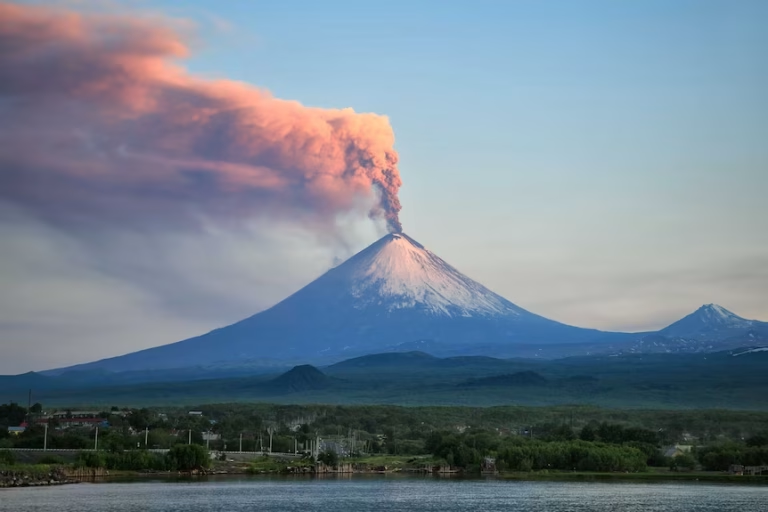
On April 11, 2023 — three years ago almost to the day from California’s fishing reopener — Kamchatka’s Shiveluch volcano detonated in the largest eruption of the satellite era. Ash and mineral-rich aerosols rocketed 20 kilometers into the stratosphere. It happened on what the Russian Orthodox Church recognizes as Holy Tuesday, the day the ashes of Jesus are symbolic, and don’t forget Jesus’ passion for his Miracles of the Fishes. The plume spread across more than 100,000 square kilometers of the North Pacific. Two hundred thousand tons of sulfur dioxide entered the upper atmosphere, along with vast quantities of iron-bearing volcanic dust.
And dust carrying trace amounts of iron is the currency of life in the North Pacific.
Click to read more
The subarctic Pacific — from the Gulf of Alaska to the California Current — is what oceanographers call iron-limited. Sunlight is abundant. Nitrogen and phosphorus are present. But without iron, phytoplankton cannot photosynthesize efficiently. The ocean’s living pastures — the vast fields of microscopic plants that underpin the entire marine food web — cannot grow. Without plankton, there are no zooplankton. Without zooplankton, there are no forage fish. Without forage fish, young salmon starve.
When Shiveluch erupted, it delivered a massive pulse of the one nutrient the North Pacific was missing. The ocean’s pastures were fertilized on a scale that no human program could replicate.
And the timing was perfect. Spring 2023 — precisely when millions of juvenile salmon from rivers across the Pacific Rim were entering the ocean for the first time.
The Signal Is Everywhere
If the volcanic ash were real, you would expect to see the response not in one river system or one region but across the entire North Pacific, wherever the 2023 ocean-entry cohorts are now returning as adults.
That is exactly what we see.
Alaska recorded a 2025 total salmon harvest of 194.8 million fish valued at $541 million. Pink salmon — with their clean two-year life cycle that makes them the sharpest indicator species in the Pacific — returned at 119 million. A pink that came back in 2025 entered the ocean in 2023. Full stop. Sockeye were strong at 53 million. Chum hit 20 million. Chinook exceeded their forecast by 26 percent. Average fish weights held steady or increased even as numbers surged — a signature of abundant ocean forage, not overcrowded competition.
Washington coho forecasts for 2026 are up 11 percent for wild fish and 9 percent for hatchery stocks.
The Columbia River fall Chinook forecast stands at 651,300 fish.
Oregon is offering its broadest commercial and recreational salmon seasons in years.
And now California — the southern end of the range, the system that has been most battered — is reopening with the strongest Chinook forecast in recent memory and a jack return that stunned the people who count fish for a living. Sixty-seven thousand jacks. The previous five years combined.
The common factor across all of these systems is not rainfall in any particular watershed. It is not dam removal on any particular river. It is not hatchery production, which has been roughly steady. The common factor is the ocean — and what was in it when those young fish arrived in 2023.
2,200 Years of Evidence
This is not a new hypothesis. It is a very old one that salmon science has systematically ignored.
A landmark paper published in 2025 in Progress in Oceanography — “Iron from Asian dust drives tertiary-level productivity of Pacific salmon” — demonstrated through 2,200 years of sediment core records from Karluk Lake on Kodiak Island that sockeye salmon abundance has tracked Asian mineral dust supply for millennia. Not just plankton productivity. Fish. For over two thousand years, when the dust blew, the salmon grew. When the dust faltered, the salmon declined.
The authors stated,“The relationships revealed the critical role played by Asian dust for salmon.”
The North Pacific has always depended on two great mineral dust engines: the Asian deserts — the Gobi and Taklamakan — which loft iron-bearing dust eastward across the Pacific every spring, and the volcanic arc of Kamchatka and the Aleutians, which delivers episodic but enormous mineral pulses. Together, these systems have sustained the ocean’s productivity since long before humans started counting fish.
In 2012, a carefully designed ocean pasture restoration — delivering iron-rich mineral dust to depleted Gulf of Alaska waters — was followed the next year by the largest pink salmon return in Alaska’s recorded history. That was dismissed by some as a coincidence. Now, Shiveluch has run the same experiment at a continental scale, without anyone’s permission, and the result is the same.
But Wait — Again
Here is the part that should keep us up at night.
One good salmon season does not mean the salmon are saved. A cool January does not disprove global warming. A single volcanic eruption, however spectacular, is a pulse — not a cure.
The underlying condition has not changed. The supply of natural mineral dust to the North Pacific has been declining for decades. Asian dust sources are shifting as landscapes change. Wind patterns are evolving. The long-term iron subsidy that sustained peak ocean productivity for millennia is diminishing. Against this backdrop, salmon populations across the Pacific have been in a slow, grinding decline that occasional good years cannot reverse.
California’s three years of commercial closure were not a fluke. They were a symptom. The drought years of 2020–2022 hammered freshwater survival, yes. But the ocean was also failing those fish — clear, blue, and barren where it should have been green and teeming with plankton.
The industry damage has been staggering. Fishermen left California or left the trade entirely. Boats were sold at distress prices. The Golden State Salmon Association has called it a tremendous, avoidable hit. California has requested federal disaster assistance; only $20.6 million has arrived, covering only the 2023 closure. The human cost of depleted ocean pastures is not abstract. It is measured in livelihoods, in communities, in a way of life that may not survive the next barren cycle.
And that next cycle will come — unless we understand what Shiveluch is telling us and act on it.
A Russian Blessing In A Volcano Is Telling Us What the Medicine Is
The remarkable thing about the Shiveluch signal is its clarity. A massive mineral ash input in spring 2023 is now being followed, two and three years later, by strong salmon returns across the entire breadth of the North Pacific. Alaska. Washington. Oregon. The Columbia. California. The fish do not read fisheries management plans. They respond to the ocean. And the ocean responds to iron.
We cannot schedule volcanic eruptions. We cannot command the Gobi Desert to produce more dust. But we can understand what these natural systems provide — and we can, carefully and at modest scale, help restore what nature’s faltering dust engines no longer reliably deliver.
It’s Not Just the Salmon
It is what the salmon-centric telling of this story misses: the collapse of California’s ocean pastures has not only decimated salmon. It has been killing everything.
Seabird populations along the California coast have crashed. Colonies that once darkened the cliffs are thinning toward silence. Whales that depend on krill and forage fish — themselves products of productive ocean pastures — are starving, shifting their ranges, washing up on beaches. The entire marine food web off California, from plankton to pinnipeds, has been degrading in lockstep with declining ocean pasture productivity.
And the damage does not stop at the surface of the ocean.
Healthy ocean pastures produce the biogenic emissions that seed the formation of coastal clouds and fog — the marine layer that has cooled California’s coast and interior valleys for millennia. As the pastures have collapsed, so has their cloud-making capacity. Fewer ocean clouds means more solar heating of the land. More heating means drier soils, lower humidity, and hotter fire seasons. The catastrophic wildfires that have torn through California in recent years, the deepening droughts, the vanishing fog that once watered the redwoods — these are not separate crises. They are symptoms of the same underlying disease: the starvation of California’s ocean pastures.

Click to read more https://russgeorge.net/2026/02/07/earths-cloud-calamity-explained-part-one-of-three-ocean-pastures-clouds-and-climate/
The salmon are the messenger. But the message is about everything.
The Plan Is Ready
This is where the story turns from diagnosis to prescription. Ocean Pasture Restoration California has a plan — developed, designed, and ready to deploy — to replenish California’s ocean pastures through the same nature-based mineral restoration that Shiveluch performed by accident and that a 2012 project in the Gulf of Alaska demonstrated by design.
The objective is not a one-time experiment. It is the sustained restoration of California’s ocean pastures to historic levels of health and productivity — the levels that supported abundant salmon, thriving seabird colonies, healthy whale populations, and a functioning marine ecosystem for 10,000 years before the mineral-dust cycle faltered.
In Alaska this fall, the most important Plank(ton) in the Governor’s race is bringing back the fish. Follow this link to read about it.
Restoring those pastures will bring back the salmon — not for one good season when a volcano happens to erupt, but reliably, year after year, for the foreseeable future. It will rebuild the forage base that feeds seabirds and marine mammals. It will restore plankton pasture productivity that make cooling clouds and fog, helping to reverse the drying and heating that have made California’s fire seasons so deadly. And it will deliver what may be the single largest climate-mitigation dividend available to the state: ocean pastures photosynthesizing at full capacity are a massive carbon sink, converting CO₂ into marine biomass on a scale no terrestrial program can match.
A billion clean Negawatts — not energy produced, but carbon not emitted, atmospheric CO₂ drawn down and converted into ocean life. Added to California’s climate mitigation ledger not through new infrastructure or subsidies but through the nature-based restoration of a natural system that was already doing this work before we blew its fuse!
The volcano showed us what a healthy ocean pasture can do. The salmon are confirming it right now, from San Diego to Bristol Bay. The plan to deploy ocean pasture stewardship deliberately, responsibly, and sustainably is ready. The ocean is waiting.
California is going fishing this spring. That is worth celebrating. But the real prize is not this season’s catch. It is the restoration of the ocean pastures that makes every season’s catch possible — and with it, the restoration of California’s climate, its coasts, its marine life, and its future.