Twenty Five Amazon Forests Drowning Beneath The Waves
The Eco-Crisis That Dwarfs the Amazon — And Why You’ve Never Heard of It
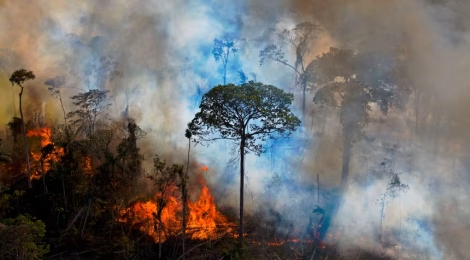
Walk into any classroom, scroll any feed, sit through any climate fundraiser, and the same green icon flashes by: a chainsaw at the edge of the rainforest.
The Amazon is “the lungs of the planet.” The Amazon is “burning.” The Amazon is approaching its “tipping point.”
For four decades, the Amazon has been the brand-name eco-crisis of our species — repeated so often it has become shorthand for environmental catastrophe itself.
The Amazon crisis is real. It is also, by any honest accounting, the smaller of the two great living-system collapses now underway on Earth.
The larger one is happening underwater, almost completely unmarketed, and it dwarfs the Amazon by more than an order of magnitude.
What the rainforest scientists actually say
The most rigorous recent reconstruction of Amazon forest loss comes from the Monitoring of the Andes Amazon Program (MAAP), the team that built the first quantitative estimate of the original pre-Columbian Amazon biome. Their 2022 analysis, dedicated to the late Tom Lovejoy, put the original Amazon biome at 647 million hectares — about 1.6 billion acres — across nine countries.
Of that original forest, MAAP documented a cumulative historic loss of roughly 85 million hectares. That is 13.2% of the original Amazon, gone. In the eastern third of the basin, where the rainforest’s self-generated rainfall begins its westward journey, the loss is steeper — about 31%, already past the speculated tipping-point threshold of 25%.
Thirteen percent basin-wide. Thirty-one percent in the east. These are the numbers behind every “Amazon is dying” headline you have ever read.
Hold those numbers in mind. They will be useful in a moment.
The other living biome
Now turn around and face the sea.
The world’s oceans cover 71% of the Earth’s surface — an area more than fifty times larger than the Amazon biome. Across that vast blue surface, the actual life of the planet is not the whales, the tuna, the corals, or the kelp forests we put on calendars. The life of the planet is the phytoplankton: the single-celled drifting plants that make up what marine ecologists call the ocean pastures.
Phytoplankton are not a marginal feature of the biosphere. They produce far more than the “half of all the oxygen” we breathe, we are told by forest-centric pitchsters. They are the base of every marine food web. They are the original carbon pump, managing 90% of the CO₂ out of the atmosphere and sinking it into the deep. They emit biogenic compounds that seed the marine clouds that cool the planet. Before there were forests, there were ocean pastures. The continents are, in a real sense, the latecomers.
And the ocean pastures are collapsing.
The peer-reviewed literature — most prominently Boyce et al. in Nature (2010) and the work that has followed — points to a global decline in phytoplankton on the order of about 1% per year since 1950. A more honest reading of the open-ocean data, where the worst declines occur, suggests something closer to 1.5% per year.
Compound those rates over seventy-five years and you get the staggering result:
- At 1% per year → roughly half the ocean’s primary productivity is gone.
- At 1.5% per year → roughly two-thirds is gone.
We are not talking about a fishery here, or a charismatic species, or a scenic ecosystem. We are talking about the photosynthetic engine of more than two-thirds of the surface of the Earth — the foundational layer of life on this planet — and somewhere between half and two-thirds of it has already vanished.

The math the marketing won’t show you
Let’s do the comparison the eco-fundraisers don’t put on their billboards or in their “donate here” email blasts.
The Amazon biome, in MAAP’s accounting, has lost about 13-20% of one Amazon’s worth of life. That is the loss being shouted from every rooftop, taught in every classroom, monetized in every green prospectus.
The world’s ocean pastures cover an area more than fifty times the size of the Amazon biome. They have lost, on the conservative end, half of their primary productivity since 1950. On the more realistic end, two-thirds.
Even if you set the ocean loss at the most cautious estimate — 50% of productivity across an area fifty-plus times the Amazon’s footprint — you are looking at the biological equivalent of more than twenty-five Amazons of life subtracted from the planet, in roughly the same window of time the actual Amazon has lost a fraction of one.
By any honest reckoning, the oceans have lost the equivalent of 25 Amazons or more while the Amazon itself was losing 13-20% of one. Twenty-five is, if anything, a charitable framing.
So why have you never heard this?
The branding of an eco-crisis
The Amazon crisis is real. It is photogenic. It is geographically bounded. It has identifiable villains: the rancher, the soybean baron, the road-builder, the fire. It produces beautiful satellite images of red squares eating a green carpet. It has charismatic megafauna — jaguars, macaws, river dolphins. Indigenous communities, who deserve every defense, give the story a moral spine. And the funders of the conservation industry — government aid agencies, large foundations, carbon-market intermediaries — have spent four decades building campaigns, NGOs, and credit instruments around its protection.
The Amazon, in short, is bankable. It fits on a poster, on a banner, in an email, it’s Tweetable!
The ocean pastures are a poor second cousin to these things.
You cannot photograph a 1.5% annual decline in phytoplankton from a helicopter. There is no fence to put around them. The villain is not a chainsaw but a planetary chemistry shift — diminished mineral dust transport from drying continents, a feedback driven in part by rising CO₂ growing vastly more dryland grass cover and locking dust in place. More grass growing means less dust bowing. (I have written about this terrible irony at length in “The Hegemony of Grass Is Killing Our Blue Planet”.) The victims are not jaguars but invisible single-celled drifters whose collapse cascades upward into the salmon, the seabirds, and the whales we do notice — and by then the cause is far offstage.
The ocean pastures, in short, are illegible. They do not compete well in the green market. They do not generate a satellite-image-of-the-month. They are not invited to lend themselves to a feel-good pitch you can sell at a Davos panel.
So the conservation industry, like any industry, has optimized for the bankable product. The Amazon gets the campaigns. The oceans get a damning-with-faint-praise mention at the end of the press release.

The bait and switch
This is not an argument against caring about the Amazon. The eastern Amazon really is past its tipping threshold. The forest really does generate its own rainfall in a hydrological cycle that, once broken, will not easily be repaired. Every hectare saved is a hectare worth saving, and the people doing that work — including the MAAP scientists who produced the numbers cited above — deserve our support.
The argument is against the crowding out. When a single, telegenic, well-marketed crisis absorbs the lion’s share of public attention, philanthropic money, scientific funding, and political capital, the larger, far more vital but less photogenic crisis goes unattended. We have built an entire generation of environmental literacy around the rainforest, and that literacy has come at a cost: most educated adults today cannot tell you what a phytoplankton bloom is, why it matters, or that it is disappearing. (Cf. my essay “How Little We Sea”.)
This is not the rainforest’s fault. It is a failure of attention — and of the institutions whose job it is to direct that attention. It’s also the intent of determined, competitive, well-funded marketing campaigns.
The nature-based fix that exists already
Here is the part that should make the disproportion unforgivable.
The Amazon, in many places, is genuinely hard to restore. A mature rainforest is a multi-century project. Some of the cleared land will not come back to forest in any human lifetime; some of it will not come back at all if the regional rainfall cycle collapses.
The ocean pastures are not like that.
Phytoplankton blooms respond to mineral nutrient inputs — chiefly iron — on a timescale of weeks. When a volcano like Iceland’s Eyjafjallajökull in 2010, or Kamchatka’s Shiveluch in 2023, dumps a load of iron-rich ash across a barren stretch of ocean, the pasture greens up almost immediately, literally overnight! Fish stocks downstream of those events have shown the response, sometimes spectacularly, within a single salmon-return cycle.
This is not theory. It is an observation of a fact of Nature. The ocean pastures, unlike the rainforest, are a system whose decline is reversible on human timescales if we are willing to replenish the missing dust. Restoring nature’s own mineral-dust cycle to the open ocean is not geoengineering in any radical sense. It is putting back the iron the wind used to deliver before we changed the chemistry of the continents and created the greatest drought this planet has ever experienced, a drought of dust-fall.
A rainforest takes centuries to grow. An ocean pasture takes days.
We have spent forty years and uncountable billions on the harder problem, while ignoring the larger and easier one.
A more honest conservation
None of this requires walking away from the Amazon. It requires walking toward the ocean with at least equal seriousness.
That means honest accounting first: an environmental movement that talks about the planet’s living systems in proportion to their actual size and their actual rate of loss, instead of in proportion to how well their imagery polls and sells. It means scientific funding that follows the magnitude of the problem rather than the visibility of the brand. It means treating the ocean pastures — the photosynthetic majority of the planet — as something more than a footnote in the climate conversation.
And it means, finally, telling the public the simple arithmetic.
The Amazon has lost 13-20% of one Amazon. The oceans have lost the equivalent of a twenty-five Amazons or more. They are losing more every year. The cure for the larger loss is cheaper, faster, and better understood than the cure for the smaller one.
If the eco-crisis we have been sold is the one we keep paying attention to, while the eco-crisis 25 times its size drowns quietly under the surface, then the green marketing has won and the planet has lost.
It is past time to flip that ratio.
Sources: Finer, M. & Mamani, N. (2022) “Amazon Tipping Point — Where Are We?” MAAP #164. Boyce, D. G. et al. (2010), Nature — global phytoplankton decline. Further discussion of ocean pasture collapse and restoration throughout this site.