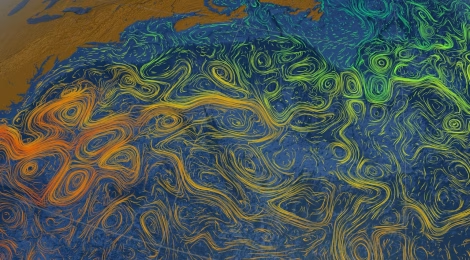
We Must Restore The Ocean’s Lost Motion
Ocean Pasture Restoration Can Reawaken the Immense Biological Forces That Cool the Sea and Help Keep Its Great Currents Moving
The slowing of the world’s great ocean currents is usually and woefully described as a simply defined problem of physics.
The surface ocean is warming. Ice is melting. Fresh water is entering the North Atlantic and Southern Ocean. Warm, fresh water is lighter than cold, salty water, so the ocean becomes more strongly layered. Surface water becomes less able to mix downward, dense water becomes less able to form and sink, and the immense overturning circulation that transports heat, oxygen, salt, carbon and nutrients around the planet begins to weaken.
That description is physically correct—but biologically incomplete and nonsensical.
It treats the ocean as though it were an enormous lifeless vessel of salt water stirred only by wind, tides, waves, gravity and differences in temperature and salinity.
The ocean is not lifeless water.
It is a living fluid filled with uncountable multitudes of swimming organisms.
Some biologists count the number of copepods in the oceans as being equal to the number of stars in the Universe, and the similarity does not end there: the ‘stars’ of our oceans are largely nocturnal.
Every night, vast communities of zooplankton, krill, fish and other creatures rise like stars from dark, cold depths toward the surface to graze on the food growing by the light of their—and your—favourite star, our sun. Every morning, they return downward to escape daylight and predators. This diel vertical migration is commonly called the greatest migration on Earth. It takes place across immense areas of ocean, every day and every night.
I have previously described witnessing and measuring this extraordinary living event in Feeding the Greatest Migration on Earth.
While each animal is small, their collective movement is not.
Their trillions upon trillions of tiny fins, feet, flippers, flagella, bodies and wakes displace water. They produce powerful flows, jets, vortices and turbulence. They drag parcels of warm surface water downward and carry cooling deeper water upward. They transport nutrients, carbon, oxygen, heat, salt and living material across layers that would otherwise remain more sharply separated.

The great currents of the ocean are not driven by animals alone; ocean life shares that work equally with the winds and tides. The winds push from above. The tides answer the moon. The migrating multitudes work throughout the inhabited water column, exactly where their mixing, transport and living motion are needed.
They are key to maintaining the motion in their ocean. Their power of living motion cannot be lost without consequence.
The Missing Ocean Mixing Engine
Physical oceanography has traditionally assigned all ocean mixing energy to winds and tides. Those forces are unquestionably immense. Yet much of their energy enters at the surface, along continental margins or over rough seafloor topography. Before it reaches the quiet interior ocean, a great deal is dissipated.
Biological energy is different.
It is captured from sunlight by phytoplankton, invested in life and passed through the food web. It is then released as motion throughout the water column by organisms living exactly where mixing is needed most.
Zooplankton do not have to transmit energy from the moon or from a distant storm. They carry their harvested and invested biological energy directly into the ocean interior as their vital contribution for all—including we terrans.
Research into biogenic mixing has found that dense aggregations of swimming organisms produce turbulent energy dissipation many orders of magnitude greater than normal background turbulence. Vertical swimming is especially powerful.
In biological hotspots—healthy ocean pastures—its contribution is easily comparable to the other great sources of mid-ocean turbulence.
This does not mean that a single copepod pushes the Gulf Stream.
It means that an ocean filled with immense, recurring vertical migrations is physically different from an ocean in which those migrations have been diminished.
A living ocean is continuously tilled and tended.
Its great circular energy engines—its ocean eddies—wind up like giant flywheels, each one spinning with approximately 800 billion horsepower and gradually giving that stored motion back to the ocean over time.
For context, all the engines we humans keep running on Earth together deliver only about one-tenth of the horsepower carried by one thriving ocean eddy.
One eddy.
The ocean is filled with them.
These immense flywheels are not lifeless wheels of water. They are inhabited ocean pastures filled with phytoplankton, zooplankton, krill, fish, whales and migrating multitudes. Their inhabitants harvest sunlight, convert it into life and then convert life into motion. Through countless fins, feet, flippers and flagella, they tend, trim, steer, stir and sustain the motion held within the eddy.
The physical flywheel and the living pasture are not separate phenomena occupying the same place.
They are one evolved ocean energy ecology.
When the pasture thrives, the eddy is filled with vertically migrating life that works upon its stored power day and night. These great rotating bodies are also the ocean’s natural ecological enclosures, as explored earlier in Ocean Eddies Are Perfect Ocean Pastures.
When the pasture dies, the flywheel loses its living engineers.
The depleted ocean becomes increasingly still, sharply layered and stagnant.
That distinction has been almost entirely absent from public discussion of slowing ocean circulation.
We Have Removed More Than Fish
During the industrial era, we have not merely removed fish from the sea.
We have removed motion from the ocean!
We have depleted the great whales, fish, small fish, krill and zooplankton. We have diminished the ocean pastures that feed them. Across vast regions, a shortage of the mineral dust required for photosynthesis has resulted in formerly productive and powerful waters turning into clear-blue, quiet biological deserts.
Every lost generation of plankton means less food for the animals above them. Every missing shoal of fish, swarm of krill or layer of migrating zooplankton means less water displaced, less wake produced, less vertical transport and less biological turbulence.
This loss is repeated across every day-night cycle.
The result is not one missing pulse of energy. It is the disappearance of an immense planetary rhythm.
Healthy ocean pastures convert sunlight into life and life into organised movement. That movement does not replace winds, tides or density-driven circulation. It works with them.
Biological wakes interact like trim tabs with currents, fronts, eddies and internal waves. Animals move between water layers, consume material in one place, excrete it in another and carry carbon and nutrients through the water column.
Their collective ocean-pasture labours help keep the inhabited ocean connected vertically.
As that labour disappears, the surface ocean becomes more isolated from the water beneath it. Nutrients remain trapped below the sunlit layer. Heat remains concentrated above. Biological production falls further. Animal abundance declines again. Mixing weakens again.
Less life produces less mixing;
less mixing produces less nutrient renewal;
less nutrient renewal produces still less life.
This is the living ocean’s death spiral.
Stratification Is Not Merely a Temperature Problem
The increased layering of the ocean is generally attributed to surface warming and freshening. Those are major causes, but stratification is also an ecological condition.
Temperature and salinity determine the amount of energy required to mix two layers. Biology helps determine how much mixing energy is continually delivered within and across them.
As warm surface waters become more buoyant, every contribution to vertical exchange becomes more important, not less. Yet this is precisely the time when the biomass capable of contributing that exchange is being lost.
The same depleted ocean is therefore being struck from all directions.
Physical conditions make mixing more difficult while ecological collapse removes the vital part of the machinery that performs the most critical mixing.
This connection deserves far greater attention in discussions of the Atlantic Meridional Overturning Circulation, Southern Ocean overturning, Pacific circulation and the growing stagnation of the upper ocean.
Major currents operate at scales far beyond any single plankton bloom. Their behaviour is controlled by winds, planetary rotation, density differences, freshwater fluxes, heat exchange, bathymetry, eddies and mixing occurring across many scales.
But the condition of the upper and middle ocean matters to all of those systems. Mixing influences stratification. Stratification influences convection and water-mass formation. Water-mass formation helps sustain overturning. The overturning circulation then redistributes heat, salt, oxygen, nutrients and carbon throughout the sea.
Biology participates in this chain.
It is time to stop modelling ocean life merely as lifeless physics of water transported by alien currents and begin measuring it as one of the processes that helps shape the water through which those currents flow.
The Living Ocean Cools Itself from Above
The inhabitants of the ocean do not only mix heat after sunlight has entered the sea.
They help prevent too much of that sunlight from entering in the first place.
This is the other half of the living ocean’s evolved motion ecology—and perhaps its most powerful expression.
Healthy ocean pastures reach upward into the sky.
Their phytoplankton, bacteria, grazers, dissolved organic compounds, sea-surface films and breaking bubbles produce and transform an immense variety of biogenic gases, microscopic organic particles, salts, gels and fragments. Among the best known is dimethyl sulphide, or DMS, produced through the living sulphur cycle of plankton-rich waters.
These substances enter the marine atmosphere and become, or help form, cloud-condensation nuclei: the tiny particles around which water vapour gathers to form cloud droplets.
Without sufficient nuclei, water vapour does not readily gather into bright, enduring marine clouds.
With abundant cloud-condensation nuclei, atmospheric moisture is divided among a greater number of smaller droplets. The cloud becomes brighter and more reflective. It can become more persistent, shading the pasture beneath it for longer periods.
The living ocean therefore helps build its own parasol.
Those bright marine clouds reflect incoming solar energy back towards space before it can be absorbed by the dark sea surface and converted into heat.
This cooling reflectivity—albedo—is not a decorative feature of the planet. It is part of the ocean’s operating system.
The biological pasture below helps create the cooling cloud above. The cooling cloud protects the pasture below.
This is not a coincidence. It is a life-shaped relationship assembled and refined across immense evolutionary time.
The Ocean’s Goldilocks Zone
Ocean life thrives within ranges of light, temperature, density, nutrient supply and vertical movement that are neither too weak nor too extreme.
Too little sunlight and photosynthesis falters.
Too much unfiltered sunlight and the surface ocean overheats, stratifies and becomes increasingly separated from the cool, nutrient-rich water below.
Too little mixing and nutrients remain stranded beneath the sunlit layer.
Too much violent mixing can scatter organisms and disrupt the coherent architecture of an ocean pasture.
The living ocean evolved within a Goldilocks Zone:
Not too hot and not too cold.
Not motionless and not chaotic.
Not dark and not scorched beneath relentless sunlight.
The physical form and astonishing persistence of these living enclosures can be seen in Goldilocks Eddies, Vital Ocean Pastures, Revealed in Space Radar Movies.
Cloud albedo helps hold the upper ocean within that habitable range.
When the pasture flourishes, it produces more of the biological materials that participate in marine aerosol and cloud formation. More and brighter cloud reflects more sunlight. The sea surface remains cooler. Cooler surface water is less buoyant than overheated surface water and is therefore more willing to mix with the water below. Nutrients return more readily to the light. The pasture remains productive. Migrating animals remain abundant. Their vertical work continues.
The result is a reinforcing ecology of life, motion and cooling:
More ocean life
produces more biological aerosol and cloud-condensation nuclei;
more nuclei help produce brighter, longer-lived marine clouds;
brighter clouds reflect more sunlight;
less solar heat enters the ocean;
cooler surface water resists extreme stratification;
healthier mixing renews nutrients;
renewed nutrients sustain more ocean life.
This is the living ocean’s cooling spiral—the regenerative counterpart to the death spiral of pasture collapse.
When the Ocean Pastures Die, the Sky Loses the Sanctity of Its Tears
The death of an ocean pasture does not end at the sea surface.
When the living pasture fades, the sky above it changes.
Clouds are not the sky’s tears.
Rain is. Salve Regina, earthly life is frequently conceptualized as a “valley of tears” (vallis lacrimarum). In this context, tears are the sacred, necessary moisture that waters the soul preparing it for heavenly joy
But without clouds, the sky cannot weep.
The phytoplankton, bacteria, grazers, sea-surface films and dissolved organic life of a thriving ocean pasture release the microscopic materials from which the marine atmosphere fashions cloud-condensation nuclei.
Water vapour gathers upon those nuclei. Droplets form. Clouds gather, brighten and endure. From those clouds eventually fall the sky’s life-giving tears: mist, drizzle, rain and snow returned to ocean and land.
When an ocean pasture dies, fewer living aerosols rise from the sea. Fewer cloud-condensation nuclei are formed. Marine clouds become thinner, darker, shorter-lived or absent.
The sky loses not merely its clouds, but its capacity to gather and release its tears where those tears are needed most.
Without the pasture, the cloud falters. Without the cloud, there can be no rain. Without rain, the ancient exchange between ocean, sky and land is broken.
The living ocean feeds the sky with the seeds of clouds. The clouds shade the sea, restrain excessive solar heating and gather water into the sacred cycle of rain. Those rains return moisture to forests, rivers, soils and all terrestrial life.
The pasture below helps prepare the tears above.
When the ocean pastures die, the sky loses the sanctity of its tears.
The consequences continue below.
With fewer effective cloud-condensation nuclei, marine clouds become fewer, thinner, darker or shorter-lived. Their albedo declines. More sunlight reaches the sea. The ocean absorbs more heat. Surface waters become warmer and more buoyant. The difference between the warm surface and the cold depths grows stronger.
Stratification intensifies. Nutrient transport weakens. Plankton production falls again. Migrating animal populations shrink. Biological mixing energy disappears.
The ocean becomes hotter because it is losing clouds—and it loses still more of its living mixing machinery because it has become hotter.
This creates one continuous failure:
Less mineral dust
→ less phytoplankton
→ less pasture life
→ fewer biological aerosols and cloud-condensation nuclei
→ fewer of the sky’s cooling clouds
→ less capacity for the sky’s tears
→ less cloud albedo
→ more solar heat entering the ocean
→ stronger stratification
→ weaker nutrient renewal
→ fewer migrating animals
→ less living motion
→ still less ocean life.
The atmosphere and ocean are not two separate systems. They are one living, coupled engine.
White Carbon: Heat Prevented Before It Becomes a Problem
The cooling work of restored ocean pastures can be described as White Carbon.
Blue Carbon is carbon repurposed from atmospheric danger into ocean life and carried through food webs and longer-lived ocean pathways.
White Carbon is the complementary cooling value of sunlight reflected before it enters the ocean, heat uptake prevented, marine clouds and fog restored, and the cool surface conditions of the living pasture preserved.
Blue Carbon works upon carbon already present.
White Carbon works upon the incoming energy that would otherwise become additional heat.
The distinction matters because removing heat after the ocean has absorbed it is extraordinarily difficult. Reflecting a portion of incoming solar energy before it enters the sea is nature’s more elegant solution.
The biological mixing pump and the cloud-albedo shield therefore perform complementary tasks.
The migrating multitudes carry warm surface water downward and cooler water upward. The pasture-generated clouds reduce the thermal burden that must be mixed in the first place.
One process redistributes heat.
The other prevents excessive heat.
Together they help preserve the temperature gradients, density structure, vertical exchange and living conditions within which the ocean’s motion ecology evolved.
Clouds Belong in the Ocean-Current Discussion
Discussions of weakening ocean currents usually begin after excessive heat has already entered the water. They ask how that heat changes density, stratification, ice melt, freshwater input and deep-water formation.
That is only half the inquiry.
We must also ask why the ocean’s natural sunshade has weakened.
Cloud reflectivity is part of the ocean’s heat budget. The heat budget shapes surface temperature. Surface temperature shapes density and stratification. Stratification shapes mixing, convection and water-mass formation. These processes help determine the strength and character of major ocean currents.
Clouds are therefore not merely weather floating above the circulation problem. They are part of the circulation system.
When living ocean pastures produce bright clouds over waters most exposed to incoming sunlight, they deliver cooling exactly where it preserves the greatest amount of ecological and physical function: at the sea surface, before solar energy becomes stored ocean heat.
The same pasture is therefore working in three dimensions.
Its phytoplankton capture sunlight and build the food web.
Its animals work vertically through the sea, mixing water and transporting nutrients, carbon, oxygen and heat.
Its microscopic emissions rise into the air and help build the bright cloud canopy that protects the entire living engine below.
The ocean pasture is not merely an ecosystem beneath the weather.
It is one of the makers of the weather.
And the weather it helps make returns to govern the motion, temperature and fertility of the pasture itself.
An Evolved Ocean Motion Ecology
This is the larger idea that physical oceanography has largely failed to describe.
The ocean’s currents, eddies, clouds, plankton blooms, vertical migrations, predator movements, nutrient cycles and surface temperatures did not arise independently and later become acquainted.
They evolved together.
Ocean life adapted to moving water, but it also increasingly worked upon that water. It changed chemistry, light penetration, surface films, aerosol production, carbon transport, cloud formation and vertical turbulence.
The physical ocean shaped life.
Life then became one of the forces shaping the physical ocean.
The result is an evolved ocean motion ecology: a planetary system in which living organisms help maintain the coolness, movement, fertility and cloud cover upon which their continued abundance depends.
Remove enough of the inhabitants and the physical habitat changes.
Restore the inhabitants and their pasture, and the habitat begins repairing itself.
That is why Ocean Pasture Restoration is far more than an effort to grow more plankton or bring back more fish.
It restores the living community that helps make the clouds, cool the surface, mix the water, recycle the nutrients, manage the carbon and preserve the ocean within the Goldilocks Zone in which its great currents and living pastures developed.
The inhabitants are not passengers.
They are the ocean’s stewards, engineers and crew.
Ocean Pasture Restoration Restores Motion
Ocean Pasture Restoration begins with a minuscule replenishment of the natural mineral dust—red ocher iron hematite dust—that productive ocean regions received in sufficient amounts throughout geological time.
Today that mineral dust is failing to reach vast regions of the sea.
High and rising atmospheric CO₂ is making terrestrial plants grow more vigorously, especially the grasses occupying the great dusty regions whose winds once carried mineral nourishment across the oceans.
More grass growing means less dust blowing.
Less dust blowing means less mineral nourishment reaching the phytoplankton that feed, cool and move the ocean.
The horror!
The same excess CO₂ that is heating the sea is helping to grow the terrestrial vegetation that suppresses delivery of the mineral dust required by the ocean life that cools the sea, feeds its inhabitants, makes its clouds and restores its motion.
The purpose of OPR is not to command the ocean through machinery.
It is to restore the missing natural condition that allows the living ocean to do its own immense work.
Replenish the missing mineral micronutrients and phytoplankton photosynthesis responds. The restored pasture produces food. Zooplankton graze. Krill gather. Fish return. Whales, seabirds and the broader living community follow.
With the return of life comes the return of movement.
Millions and ultimately trillions of organisms resume their vertical journeys. Their wakes overlap. Predators pursue prey. Schools turn, dive and rise. Organic particles are consumed, repackaged and transported. Nutrients are carried upward and downward. Carbon is moved into the ocean interior. The water column again becomes inhabited by a community constantly working upon it.
OPR therefore restores more than fish production and carbon capture.
It restores biological mixing energy.
It restores a distributed, solar-powered, self-replicating ocean workforce operating every hour of every day.
No fleet of mechanical pumps could reproduce this living architecture. Machines would require fuel, maintenance and continual replacement. Ocean life feeds itself from restored photosynthesis, multiplies itself and performs many tasks simultaneously.
It produces fish.
It transports carbon.
It recycles nutrients.
It oxygenates and repopulates the water column.
It restores the sea-surface films, biological sulphur cycle, organic aerosols and microscopic materials that help produce cloud-condensation nuclei.
It helps rebuild the bright marine cloud canopy that reflects solar heat before it enters the sea.
It restores the atmospheric conditions required for mist, fog, rain and snow.
It cools the surface, reducing the excessive buoyancy and stratification that work against vertical exchange.
And beneath that cooler surface, it restores the immense physical motion of animals whose fins, feet, flippers and daily migrations reconnect the sunlit pasture with the deeper ocean.
OPR therefore restores two inseparable forms of biological cooling.
It restores the cloud-albedo shield above, which prevents excessive heat from entering.
It restores the living mixing pump below, which redistributes heat, nutrients, oxygen, carbon and life throughout the inhabited water column.
Together these processes return the ocean towards the Goldilocks Zone within which its currents, eddies, clouds, pastures and migrating multitudes evolved together.
We Must Measure What Returns
The restoration of biological mixing and cloud cooling is not an article of faith. It is a measurable proposition.
Our ecological-scale OPR projects are equipped to measure the ocean before, during and after restoration using:
- acoustic Doppler current profilers to observe vertical migration and water movement;
- multifrequency echosounders to quantify migrating biomass;
- gliders and profiling floats to measure temperature, salinity, density, oxygen and chlorophyll;
- turbulence microstructure profilers to quantify energy dissipation and mixing efficiency;
- carbon traps and optical instruments to measure vertical particle transport;
- nutrient and carbonate chemistry measurements across the mixed layer and thermocline;
- satellite observations of pasture development, surface temperature, eddies and fronts;
- biological sampling of phytoplankton, zooplankton, krill, fish and larger animals;
- dissolved DMS, DMSP and related biological sulphur compounds;
- sea-surface microlayer chemistry, organic gels, microbial fragments and aerosol precursors;
- sea-spray aerosol number, size, composition and biological content;
- cloud-condensation-nuclei concentration and activation properties;
- marine boundary-layer aerosol profiles measured by ship, buoy, drone and aircraft;
- cloud droplet number, droplet size, cloud optical depth, cloud brightness and persistence;
- low-cloud and fog frequency over the restored pasture and its downwind airshed;
- incoming and reflected shortwave radiation at the sea surface and top of atmosphere;
- pasture-scale and regional albedo change;
- sea-surface temperature, net solar heat uptake and the development or relaxation of marine heat anomalies;
- downwind moisture transport, mist, drizzle, rainfall and snowfall.
The first experimental question is straightforward:
When an impoverished ocean pasture is restored to biological abundance, how much vertical migration, turbulence, material transport and effective mixing returns with it?
A second question follows:
How does that restored biological activity alter mixed-layer depth, nutrient renewal, surface heat retention, stratification and interaction with eddies and regional currents?
The atmospheric question is equally direct:
When an impoverished ocean pasture is restored, how much of its living cloud-making and cooling machinery returns with it?
The complete system question becomes:
How does restored ocean life alter aerosol production, cloud-condensation nuclei, cloud brightness, solar heat uptake, sea-surface temperature, moisture transport, stratification, biological mixing and the interaction of restored eddies with regional and major ocean currents?
These are answerable questions.
The measurements must cross the artificial boundary between oceanography and atmospheric science because the living pasture itself crosses that boundary.
We must measure the restored system from the deepest migrating layer to the clouds above it—and onwards to the rain and snow those clouds deliver.
The world is spending billions measuring the possible weakening of great currents while spending almost nothing to investigate whether restoring the living ocean can rebuild the conditions that support them.
Biology Is the Missing Physics
The conventional division between physics and biology is an administrative convenience.
Nature recognises no such boundary.
The phytoplankton cell that captures sunlight is a solar-energy collector.
The copepod that eats it converts that stored solar energy into physical motion.
The fish that eats the copepod creates larger wakes, stronger vortices and longer-distance transport.
The whale that follows the fish redistributes nutrients and moves water across immense distances.
The pasture community releases the gases, organic gels, salts and microscopic living materials that seed clouds.
The clouds reflect sunlight, cool the sea and gather the moisture that eventually falls as rain and snow.
Every one of these is a physical act.
Every swimming body displaces water.
Every wake carries momentum.
Every cloud changes the ocean’s energy budget.
Every reflected ray of sunlight is heat that does not enter the sea.
Every parcel of cool water lifted upwards and warm water carried downwards changes the thermal structure of the ocean.
Every nutrient returned to sunlight becomes new photosynthesis, new life and new motion.
The biology is not decoration upon the physics.
The biology is physical power.
It is solar energy harvested, embodied, multiplied and put to work by the ocean’s living residents.
The omission of that power from the prevailing account of ocean circulation is not biological simplification.
It is missing physics.
Restore the Pastures, Restore the Pulse
The slowing and stratification of the ocean warn us that the planet’s great living circulation system is losing power.
We will not solve that problem by watching the currents weaken while ignoring the simultaneous disappearance of the living multitudes that stirred, cycled, cooled and connected the water column.
We will not preserve ocean motion while allowing the biological engines of that motion to die.
Nor will we restore the sea while ignoring the disappearance of the bright clouds that once shaded its pastures and prepared the sky to deliver its sacred tears of rain and snow.
Ocean Pasture Restoration reverses that loss.
By replenishing the natural mineral dust needed for photosynthesis, OPR restores the base of the food web.
By restoring the food web, it restores the animals.
By restoring the animals, it restores their immense collective movement.
By restoring that movement, it returns biological mixing, heat transport and nutrient renewal to the upper and middle ocean.
By restoring the living sea surface, it restores the biological materials from which cloud-condensation nuclei arise.
By restoring the clouds, it restores cooling shade, White Carbon, moisture transport and the capacity of the sky to deliver rain and snow.
By restoring the ocean pastures within the great eddies, it returns the living crews to flywheels carrying approximately 800 billion horsepower apiece.
The full sequence is simple:
Restore the mineral dust.
Restore the phytoplankton.
Restore the pasture.
Restore the fish and whales.
Restore the migrating multitudes.
Restore the living mixing power.
Restore the eddy flywheels.
Restore the clouds.
Restore the cooling.
Restore the rain.
Restore the evolved motion ecology of the living sea.
The great currents are the arteries of our blue planet.
The eddies are its tremendous flywheels.
The migrating multitudes are its muscle and pulse.
The clouds are its sheltering canopy.
The rain carries the sanctity of its tears.
We have allowed the pulse to fade, the flywheels to lose their living crews, the canopy to thin and the tears to fail.
Ocean Pasture Restoration brings the crews home.
It is time to restore the pastures.
It is time to restore the clouds.
It is time to restore the motion.
It is time to restore the pulse.